 |
|
|
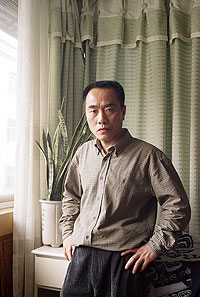
What precision there is to his paintings! What pleasing accord to his colors! The exquisite use of draftsmanship, exactness of composition, and accuracy of execution has created for us a contemporary master of realism. In the mid-1600's, when Amsterdam became the social, political and financial capital of Northern Europe, Dutch Baroque still life masters such as Abraham Hendrickz. van Beyeren (c. 1620-1690) and Willem Kalf (1622-1693) excelled at painting lush still life tableaux known as pronk. These paintings featured exotic imported fruits and expensive foreign collectibles such as coveted Chinese porcelain from the late Ming Dynasty against velvety, dramatically lit backdrops. Contemporary mainland Chinese painter Cao Hui is heir to this venerable visual tradition, though for him exotic fruits and delicate porcelains so coveted in 17th century Europe are an inherent part of his cultural legacy, as well as being his favorite subject matter for painting. Cao Hui was born in the Beilun district of the port city of Ningbo in the province of Zhejiang Province in southeast China in 1962. This province has always been the Chinese cradle of cultural and handicraft development, beginning with the Hemudu culture of 6,000 to 7,000 years ago and the Liangzhu culture (3310 – 2250 B.C.). As a child, Cao loved to sketch and practice Chinese calligraphy and painting, and was encouraged to do so by his father and mother. What his parents considered a childhood hobby eventually became an all-consuming desire to paint as a career. "Art is a kind of sustenance for me and painting is a release," explains the artist. "Even when I'm standing in front of a canvas not knowing which direction I should take, the act of painting and everything attendant to it brings me happiness." Following high school in Hangzhou City, Cao Hui obtained a fine arts degree in 1986 from China's oldest art college, China Academy of Fine Arts, also located in Hangzhou in the province of Zhejiang. The Academy, which began as The National Academy of Art, was founded by the renowned educator, Cai Yuanpei, in 1928 to promote fine arts education to replace the role of religion in then war-torn China. The academy has fostered many renowned artists who have become major artistic forces in the country, making it one of the most prestigious art institutions in mainland China. It was at China Academy of Fine Arts that Cao became steeped in Western art historical traditions. Cao was especially taken by the magic of Italian Baroque painter Caravaggio (c. 1572-1610) and the drama of this master's contrasty chiaroscuro lighting. He was equally impressed by the still lifes of the 18th century French painter Jean-Baptiste-Siméon Chardin (1699-1779), seduced by their muted colors, shimmering luminosity and emphasis on the human intimacy of unvarnished domesticity. Inspired by these techniques, the artist has produced remarkable still life compositions filled with classic Chinese objets d'art, including dynastic porcelains, antique furniture and handmade textiles, as well as fruits and flowers indigenous to Zhejiang province's semi-tropical environment. Seasonal changes and the unremitting passage of time are reflected in Cao's work -- not only by the artist's choice of flora depicted, but also by the very quality of light illuminating the objects featured in his carefully crafted paintings. Unlike 17th century Dutch and Flemish still life painters, whose primary goal was to portray ostentatious displays of imported luxury items within reach of only the wealthiest, Cao's tranquil tableaux -- evocative of work by Chardin -- bespeak of the fragile beauty of China's cultural past, which is again being appreciated and celebrated after the long drought of the country's Cultural Revolution. "My work is nostalgic, informed by both the classic fine and folk art of China," Cao states. Currently, Cao Hui, who has won awards for his paintings both in China and other countries, holds the position of vice-chairman of the painting and calligraphy department at Ningbo University, where his lectures are in high demand by aspiring student artists. He is also the director of fine art for the Artist Association of Ningbo and the vice-president of the Oil Painting and Fresco Art Association of China. Born in 1962
in Beilun, Ningbo Zhejiang Province in China, Cao’s paintings have been
compiled into fine art books and collected by museums on an international
level. Exhibitions: 1990
China First Oil Painting, Grand Exhibition
|
 |
| Back To Artist | |